
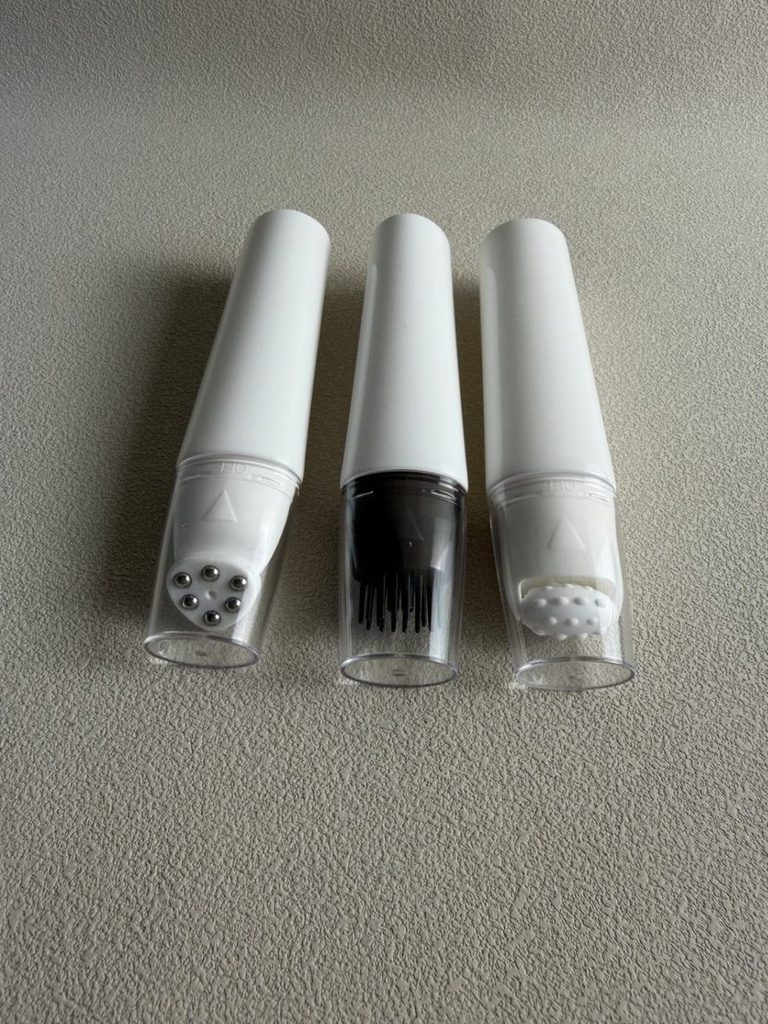
An applicator bottle is packaging that does part of the application for the user. The head — ball, comb or silicone nubs — sets the dose, decides where the product lands, and quietly determines whether the customer thinks the formula is good. This guide covers how each head behaves with real formulas, which product categories they fit, and what to test before you pay for tooling.
What an applicator bottle actually does
Strip away the branding and an applicator head performs four jobs, in this order of importance:
- Dosing. It hands the user a controlled amount — a bead of serum per stroke, not a puddle. This is why ball diameter and socket clearance matter more than the artwork on the label.
- Placement. It gets the product to a specific location: the lash line, the parting, a single spot, a cuticle. A good head makes the target obvious; a bad one forces the user to improvise with their fingers.
- Mechanical action. Rolling, combing and massaging are part of the experience — and in scalp products, part of the claimed benefit.
- Barrier. Nothing goes back into the bottle, so the formula is not contaminated by fingertips. For preservative-light or “clean” formulas this is a functional argument, not a marketing one.
If a brief only specifies “a serum in a roller bottle”, it is under-specified. The useful brief names the formula’s viscosity, the target area, the dose the brand wants per use, and the shelf life — everything else follows from those four.
The three heads, side by side

| Head | Dose per use | Formula range (rule of thumb) | Typical products | Watch out for |
|---|---|---|---|---|
| Roller ball (single or cluster) | Small, repeatable; set by ball diameter | Watery to thin gel, roughly <2,000 mPa·s | Lash and brow serum, lip oil, spot treatment, under-eye serum, deodorant, scalp tonic | Leaks if the seat tolerance is loose; steel corrodes with low-pH or high-alcohol formulas |
| Comb | Medium; runs between tines along a parting | Thin fluid to medium gel, roughly 500–10,000 mPa·s | Scalp serum, hair growth tonic, root touch-up colour, beard oil, cuticle oil | Tine spacing vs. hair density; product starvation if the exit hole is too small |
| Silicone nubs | Larger; squeezed through flow holes | Gel to cream, roughly 5,000–50,000 mPa·s | Body contouring gel, cleansing gel, scalp massage treatment, lip scrub | Dose too generous for expensive actives; nub hardness changes the massage feel |
The viscosity bands above are starting points for sampling, not specifications. A 1,500 mPa·s gel can behave like a watery serum if its yield point is low, and an oil can be thin but slow to flow. Fill trials settle it in an afternoon.
Roller ball heads: dosing by geometry
A roller ball is a sphere held in a socket. Product sits behind it; as the ball turns, a film of liquid is transferred to the surface. Nothing is pumped, nothing is squeezed — which is exactly why the same format works for a €4 lip oil and a €70 lash serum.
Single ball vs. cluster
A single ball delivers a narrow line: precise, but slow over a large area. A cluster of five or six balls — the left-hand bottle in the photo above — spreads the same thin liquid across a wider patch in one pass. That makes clusters the natural fit for scalp tonics and body products, where the user wants coverage, and single balls the fit for the lash line, a spot, or a nail.
Ball material is a formula decision
- Stainless steel — the default for aqueous and oil systems. Smooth rotation, cold-touch feel that supports “depuffing” claims, and the best perceived quality.
- PP — inert. Use it when the formula is acidic (AHA/BHA, low-pH vitamin C), salty, or alcohol-heavy, where steel can discolour or corrode over shelf life.
- Glass — inert and non-reactive for fragrance oils and sensitive actives, at higher cost and with breakage risk in transit.
The most common roller-bottle failure is not the ball, it is the seat. If the interference between ball and housing is too loose the bottle weeps at 30 °C; too tight and the ball drags or stops turning. Both are controlled on the mould, so this is a tooling decision made once — sample it with the real formula, not with water.
Comb heads: reaching the scalp, not the hair
Scalp products have a delivery problem that no ordinary dropper solves: the target is under hair. A comb head solves it mechanically — the tines part the hair, the product exits between them, and the user draws the head along the parting. Dose is controlled by how far the bottle is tilted and how fast it is drawn, which is intuitive enough that most users get it right on the first try.
Two dimensions decide whether it works: tine spacing (too wide and the product runs onto the hair; too narrow and it clogs with gel) and exit-hole diameter (too small starves the flow on a cold bathroom morning; too large floods the first stroke and empties the bottle in a week). Both are cheap to change on a sample, expensive to change after tooling.
The same head is also the standard format for root touch-up colour and beard oil — anywhere the product must be laid along a line rather than dabbed on a point.
Silicone nub heads: thick formulas and massage
When the formula is a gel or cream, gravity will not do the work. A silicone head with flow holes between rounded nubs lets the user squeeze product out and work it in with the same tool. That combination — deliver and massage in one gesture — is why the format dominates body contouring gels, cleansing gels and scalp massage treatments.
- Hardness (typically 30–50 Shore A) sets the feel. Soft reads as gentle and “spa”; firm gives a more mechanical, treatment-like massage.
- Nub geometry (round, conical, ridged) changes both sensation and how evenly product spreads.
- Flow-hole count is the dose dial. Few holes suit a 50 ml treatment used twice a week; many holes suit a body gel used daily.
Because these heads are usually a separate silicone part assembled into a PP collar, they are also the easiest to re-spec without touching the bottle mould — a useful lever when a brand wants three SKUs from one body.
Which head for which product
| Product category | Recommended head | Why |
|---|---|---|
| Scalp serum / hair growth tonic | Comb, or multi-ball cluster | Must bypass hair and cover a parting line |
| Lash and brow serum | Single micro ball | Millimetre placement along the lash line, tiny dose |
| Lip oil / gloss | Single ball | Viscous product, hygienic, no fingertip contact |
| Acne spot treatment | Single ball (PP if low pH) | Point dosing; acid formulas need an inert ball |
| Under-eye serum | Single steel ball | Cold metal supports the massage claim |
| Deodorant | Large single ball | Broad, even film on a curved surface |
| Body contouring / firming gel | Silicone nubs | Thick gel plus massage in one step |
| Cleansing gel or oil | Silicone nubs | Spread then work into the skin |
| Root touch-up colour | Comb | Viscous product laid along a parting |
| Beard oil / cuticle oil | Comb or ball | Line application, low dose |
Decide in three questions
- Where must the product land? A point (ball), a line (comb), or an area (cluster or silicone).
- How thick is it? Under ~2,000 mPa·s: ball. Middle: comb. Gel/cream: silicone nubs.
- Does it attack metal? Low pH, high salt or high alcohol: PP or glass ball, not steel.
Formula and material compatibility
Applicator packs fail more often on chemistry than on mechanics. The parts that touch product are the ball or tine material, the collar plastic, the silicone head and the gasket, if any — and all of them see the formula for the whole shelf life, at whatever temperature the customer’s bathroom reaches.
- pH. Acidic systems below roughly pH 4 are the usual reason a steel ball discolours or a plated housing pits. Test with the real formula, not a placeholder.
- Solvents and alcohol. High ethanol content softens some plastics and stresses press-fit joints. It also changes flow rate, so re-check the dose.
- Oils. Fine for steel and PP; the risk is creep along the ball seat, which shows up as an oily ring on the shoulder after a few weeks.
- Actives and pigments. Suspended particles can block comb exit holes and silicone flow holes. If the formula is a suspension, size the holes against the largest particle, not the average.
- Preservative strategy. A no-touch applicator reduces recontamination, but it does not remove the need for a preservative system — do not let the pack design talk you out of a challenge test.
Filling, assembly and leak control
These bottles are normally filled through the neck, then the head is pressed into the collar — a friction fit. Three things decide whether the pack survives a pallet and a flight:
- Fill level. Product must stay below the shoulder with a defined headspace. A bottle filled to the brim will weep at the ball seat as soon as cabin pressure drops.
- Press-fit force. Too light and the head lifts under pressure; too heavy and the collar cracks. It is a machine setting plus a mould tolerance, so it has to be validated on the actual tool.
- Cap seal. The transparent overcap is not decorative — it keeps the head clean and gives a second barrier in transit. Check that the cap does not press on the ball or the tines.
Ask for the test record, not the promise: an inverted leak test over 24–48 hours, a vacuum or pressure leak test on the assembled pack, an accelerated stability check at elevated temperature for two to four weeks, and a drop test on the packed carton. XINDE inspects finished goods to AQL 1.0 and runs these checks before packing.
Decoration: where ink is allowed to go
The body and shoulder can carry the full decoration menu — screen printing, hot stamping, spray coating, soft-touch coating and labelling. What matters for applicator packs is sequencing:
- Mask the head seat. Ink or primer on the ball seat, the tine root or the silicone collar changes the fit and the flow. Masking is cheaper than sorting out a weeping batch.
- Decorate before assembly. Printing a bottle that already has a head pressed in risks ink transfer onto the applicator and complicates rework.
- Keep the transparent cap transparent. It is the window through which the customer judges the head — a frosted or heavily printed cap hides the one part that makes the product different.
- Small type on a small bottle. A 20 ml body leaves little room; agree the minimum type size with the printer before the artwork is finalised.
The four tests to run before tooling
- Fill trial with the real formula. Measure dose per stroke (ball) or per draw (comb) and per squeeze (silicone). Ten users, one bottle each — the spread tells you whether the dose is stable enough to claim a “one-month supply”.
- Inverted leak test, 24–48 h. Then a vacuum or pressure test on the same samples.
- Compatibility at elevated temperature. Two to four weeks is the usual screening window; check for discolouration, odour, weight loss, and any change in ball rotation or flow.
- Drop and transit test. Packed cartons, drop on corner and edge, then inspect the heads — a cracked collar often shows up as a slow weep, not a visible break.
What to send a supplier
A brief that gets a useful answer within a day, instead of three rounds of guessing:
- Formula type and measured viscosity (mPa·s), pH, alcohol content, and whether it is a suspension
- Target area and the dose the brand wants per use
- Fill volume in ml, plus the shelf life and storage conditions you claim
- Head preference, or the target area and let the supplier propose the head
- Decoration: colours, coverage, whether the cap stays clear
- Market: EU or US, because that decides which claims and material declarations you need on the pack
Why brands run applicator packs with XINDE
XINDE Packaging (Guangzhou Xinde Plastic Products Co., Ltd.) is a cosmetic packaging source factory with two decades of one-stop service. For applicator projects that means:
- 20 years of experience and 1,000+ ready molds across PET, PP, PE, PETG and PS — worth asking about first, because an existing body plus a new head is far faster than a new bottle.
- In-house blowing, injection, spraying, hot stamping, screen printing and labelling, so head, body and decoration are not three suppliers with three lead times.
- ISO 9001 quality system, 10+ patents, national high-tech enterprise certification.
- 8,600 m² plant including a 5,000 m² dust-free workshop, inspection to AQL 1.0.
- Free 3D design within 24 hours, including head mock-ups so the dose can be judged before tooling.
Have a formula and a target area?
Send the viscosity, the fill volume and where the product must land. We will come back with a head recommendation and a 3D mock-up within 24 hours. Get a Free Quote →
Frequently Asked Questions
What is an applicator bottle used for?
It is a small cosmetic bottle whose closure is also the delivery tool — roller ball, comb, silicone nubs or brush. It is used where placement matters more than bulk dispensing: scalp serums, lash and brow serums, lip oils, spot treatments, cuticle oil, root touch-up colour and massage gels.
Which applicator head suits a watery serum versus a thick gel?
Rule of thumb: watery to thin gel (roughly under 2,000 mPa·s) suits a roller ball; medium viscosity suits a comb that lets product run between the tines; thick gels and creams need a silicone nub head with flow holes. Viscosity, not product category, should drive the choice — confirm with a fill trial.
Can a steel roller ball handle low-pH or alcohol-heavy formulas?
Not always. AHA/BHA acids, high alcohol content and some salt-rich formulas can discolour or corrode a steel ball and its housing over shelf life. Use a PP or glass ball for those systems and run a compatibility test with the actual formula at elevated temperature.
Do applicator bottles leak during air freight?
They can, if the head is under-fitted and the bottle is filled too high. Air freight creates pressure differentials that push product past the ball seat or tines. Specify a maximum fill level, ask for an inverted leak test plus a vacuum or pressure test, and air-ship samples before the first bulk order.
Can applicator bottles be screen printed or hot stamped?
Yes — body and shoulder accept screen printing, hot stamping, spray coating, soft-touch coating and labelling. The head area should be masked, and decoration should happen before the head is pressed in, otherwise ink ends up on the applicator.
Are applicator bottles recyclable?
A mono-material PP or PET body performs best, but a steel roller ball is a second material that the user has to remove and that can disturb sorting. If you plan to claim recyclability, keep materials to a minimum, document the disassembly step, and have the claim checked against your market’s rules.
How do I validate an applicator head before mass production?
Four steps: fill trial with the real formula to measure dose; a 24–48 hour inverted leak test plus vacuum test; accelerated compatibility at elevated temperature for two to four weeks; and a drop test on packed cartons. Approve a sealed first-article sample before the run.
Related reading: PET Preform Injection Molding for Cosmetic Bottles: What Brands Must Check Before Mass Production · Cosmetic Bottle Blow Molding: What Brands Should Check Before Mass Production