Screen printing — also called silk screen printing — is one of the most popular ways to put a brand logo, product name, and simple artwork onto plastic cosmetic bottles. This guide explains how the screen stencil is made, how the process runs, where it shines, which materials it suits, and how to avoid the common quality pitfalls. It is based on XINDE Packaging’s in-house production know-how, with real photos and video from our floor.
What Is Screen Printing on Plastic Bottles?
Screen printing uses a finely woven mesh stencil (the “screen”) made from your artwork. Ink is pressed through the open areas of the mesh directly onto the bottle surface. In the words of our production team: “Screen printing builds a screen plate from the customer’s artwork, then forces ink through the mesh onto the product.”
The defining trait is the thick ink layer. Because ink is laid on rather than sprayed as a thin film, the result has a raised, tactile feel you can feel with your finger — a hallmark of premium cosmetic packaging. It is best suited to flat or regularly curved surfaces (think cylindrical PET serum bottles, rectangular cream jars, and tube bodies).
How the Process Works (Step by Step)
- Artwork & stencil making. Your logo or text is separated into spot colors and a dedicated mesh screen is prepared for each color. Each screen must be coated, exposed, developed and inspected before it goes on press.
- Surface preparation. Plastic surfaces — especially non-polar PE and PP — are cleaned and treated (corona or flame treatment) so ink adheres. Our standard requires a surface tension of at least 36 dynes/cm (verified with a dyne pen) before printing.
- Printing. Ink is squeegeed through the screen. A large print area is typically one color per pass; modern servo-driven printers can output up to 3 colors in one setup, and multi-pass production supports up to 6 colors with accurate registration.
- Curing / drying. The ink is dried or UV-cured so the layer sets hard and stays put.
- Inspection. Every piece is checked for adhesion, registration, and color match against the approved standard panel before packing (XINDE inspects to AQL 1.0).
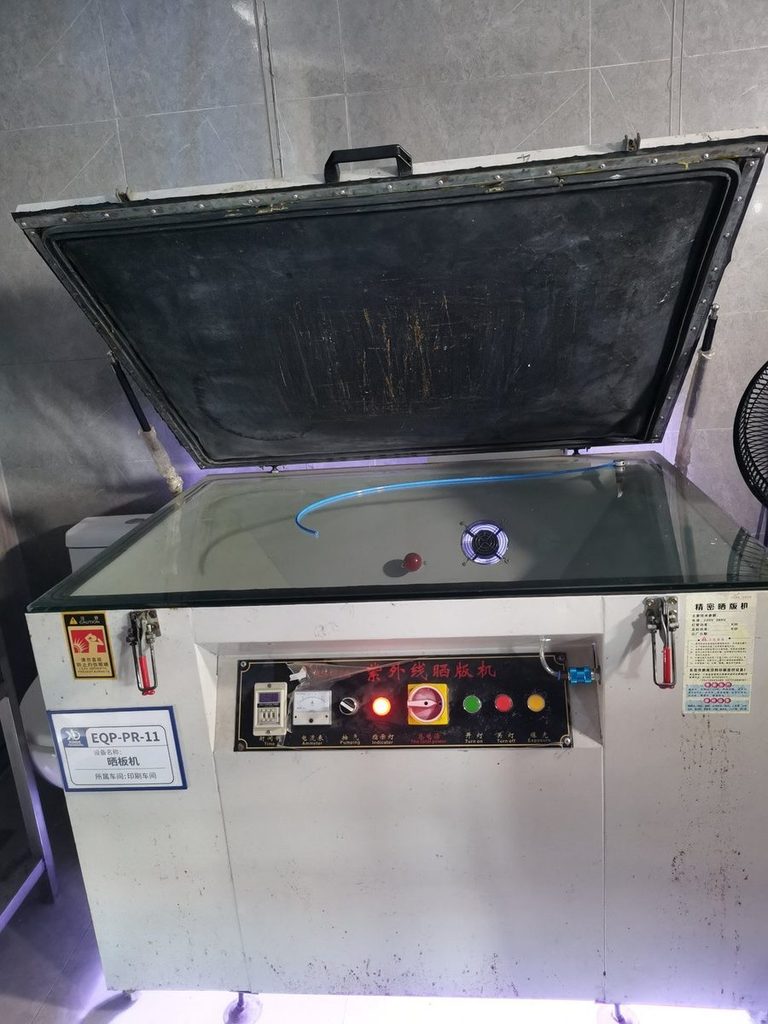
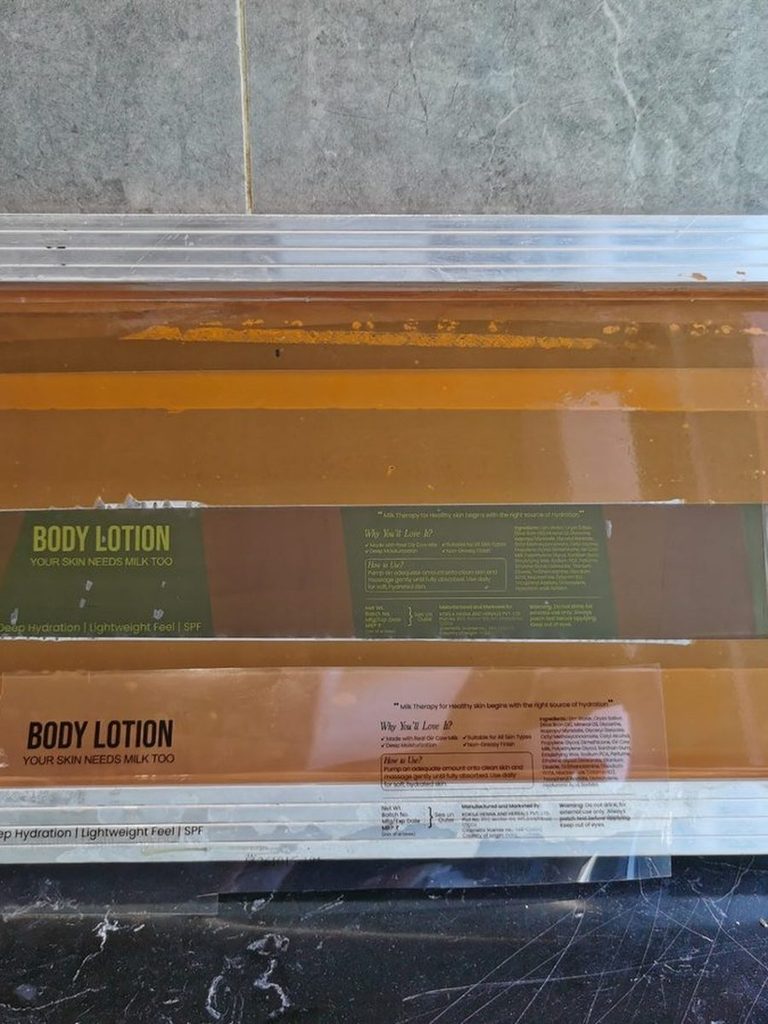
Inside Screen Making: Exposure Unit & Stencil
Most of screen-printing quality is decided before the press starts. If the stencil is right, edges are crisp and registration is stable; if it is not, no amount of careful printing will save the run. The two photos below are from our plant — one is making the stencil, one is the finished stencil.
The part clients most often overlook is small type. How small screen printing can go depends on mesh count, emulsion thickness and ink grind — not on your file resolution. The same legal line at 4 pt may close up on a 300-mesh screen and read cleanly on 420 mesh. Tell us your minimum type size with the artwork; it is far cheaper than a reprint.
From Our Line: Auto Screen Printing + Hot Stamping on 50% PCR
The clip below shows a combination we run often: a 50% PCR high-gloss black bottle. The body is made with recycled content and finished high-gloss, then decorated by an automatic screen printer — underbase and graphics — with local hot stamping as the accent.
Light ink on a dark body is one of the harder jobs in screen printing. The dark base swallows reflection, so the eye picks up any ink unevenness, pinholes or registration drift immediately; and a high-gloss black surface shows dust, fingerprints and scratches better than almost anything else. That is why dark-bottle printing is really a test of plant environment — our printing and assembly run in a dust-free workshop — and of first-article discipline, not of machine speed.Video50% PCR high-gloss black bottle · auto screen printing & hot stamping. 55 seconds, shot on our own line — no stock footage.
Key Advantages & Characteristics
- Tactile, premium look. The raised ink reads as high-end and helps a bottle stand out on the shelf.
- Spot colors & crisp detail. Screen printing uses spot colors, making it ideal for logos, small text, and line art. Color blocks are typically small and precise.
- Durable adhesion. With correct pretreatment and curing, prints resist rubbing and flaking far better than a sticker would.
- Cost-effective for simple artwork. No per-unit label material, and tooling is straightforward for 1–3 color logos.
- Stacks with hot stamping and coating. “Screen-printed base + local hot stamp” is the most common premium combination; the process order is fixed at sampling.
Tip: Screen printing (raised, spot-color) is different from offset printing. Offset is like paper printing — large, multi-color areas with a smooth, flat surface and no raised feel. Choose screen printing when you want a logo you can feel.
Screen Printing vs Other Decoration Methods
| Method | Best for | Look & feel | Notes |
|---|---|---|---|
| Screen printing | Logos, small text, line art | Raised, tactile, spot color | 1–6 colors; great adhesion on treated plastic |
| Hot stamping | Metallic logo & lines | Luxurious foil, wear-resistant | Common for premium logo finishes |
| Spray coating | Full-color body, matte/gloss | Smooth painted surface | Needs primer on PE/PP; UV or bake cure |
| Labeling | Complex, full-color artwork | Flat sticker | Fast design changes; can peel over time |
| Water transfer | All-over patterns | Wrapped graphic | Good for 360° decorative prints |
Many cosmetic brands combine methods — for example, screen-print the logo and label the regulatory text, or screen-print the base and hot-stamp the logo — to balance cost, durability, and design flexibility.
Material Compatibility: PET, PETG, PP, PE, PS
Screen printing is compatible with virtually all common cosmetic bottle materials we produce:
- PET / PETG — the workhorse for serum, lotion, and shampoo bottles; smooth surface takes ink well after light treatment.
- PP / PE — non-polar and harder to bond; must be corona- or flame-treated to ≥36 dynes/cm for reliable adhesion.
- PS — common for cream jars and thick-wall showcases.
- PCR (recycled) — eco-friendly options are fully printable; batch-to-batch shade variation in recycled resin has to be pinned down with a standard color panel and an approved sample (see the black bottle video above).
Quality Control & Registration Tolerances
XINDE’s production and QC team controls three things above all:
- Adhesion: no ink loss or flaking. Pretreatment and cure are verified on every batch.
- Registration: multi-color prints must align precisely. On our high-speed servo lines we hold tight registration (down to ~0.1 mm on rigid bottles); on cosmetic tubes the typical tolerance is about ±0.8 mm and varies slightly with tube diameter.
- Color match: finished color must match the approved standard panel exactly — no guesswork.
Surface condition matters too: the bottle must be free of dust, fibers, fingerprints, and oil (especially on large color areas), and the surface should be neither too rough (causes pinholes) nor too smooth (hurts adhesion). Dark high-gloss bottles — like the 50% PCR black bottle in the video above — raise the bar on all three.
Design Tips for Brands
- Use spot colors for your logo; avoid ultra-fine gradients across large areas.
- Keep small text legible — screen printing excels at crisp, simple artwork, not photo-realistic images — and state your minimum type size when you send artwork.
- Decide early between a raised logo (screen print) and a metallic foil (hot stamp) for the premium finish — or plan both.
- Plan for 1–3 colors to keep cost and lead time low; more colors mean more passes.
- Provide a physical or digital standard color panel so QC can match it exactly; for dark bottles, approve a first-article sample before mass production.
Why Choose XINDE for Screen Printing
XINDE Packaging (Guangzhou Xinde Plastic Products Co., Ltd.) is a professional cosmetic packaging source factory in China with two decades of one-stop service. What this means for your screen-printing project:
- 20 years of experience and 1,000+ ready molds across PET, PP, PE, PETG, and PS.
- Full-auto servo screen-printing machines, plus in-house blowing, injection, spraying, hot-stamping, and labeling lines; stencil making and UV exposure are done in-house, so artwork revisions do not wait on an outside vendor.
- ISO 9001 quality system, 10+ patents, and national high-tech enterprise certification.
- 2,600+ m² factory with 12 production lines, with inspection to AQL 1.0.
- Free 3D design support within 24 hours and a full decoration menu: screen printing, spray coating, hot stamping, labeling, and water transfer.
Ready to print your brand on a bottle?
Send us your artwork and bottle spec — we’ll return a 3D proof and a screen-printing quote within 24 hours. Get a Free Quote →
Frequently Asked Questions
What materials can be screen printed on plastic bottles?
Nearly all common cosmetic bottle materials: PET, PETG, PP, PE, PS, and PCR. PE and PP need corona or flame treatment to ≥36 dynes/cm for durable adhesion.
How is a screen printing stencil made?
Four steps: coat the mesh with photo emulsion and dry it → expose it in a UV exposure unit with the film positive under vacuum → develop with water so the unexposed artwork opens up → touch up, inspect and mount on press. All of it happens in-house at XINDE, which keeps revisions fast.
How many colors can be screen printed on a bottle?
One color per pass by default; servo printers can do up to 3 colors in one setup, and multi-pass production supports up to 6 colors with accurate registration. Screen printing uses spot colors — ideal for logos and small text.
Is screen printing durable on plastic bottles?
Yes. The thick, cured ink layer is tactile and abrasion-resistant, and with proper pretreatment it does not easily flake or fade — which is why it is widely used for cosmetic branding.
Screen printing vs labeling: which is better?
Screen printing gives a premium, integrated, peel-free logo at no per-unit label cost. Labeling is better for complex full-color artwork and fast design changes. Many brands use both.
What is different about screen printing on dark or high-gloss bottles?
Light ink on a dark body needs high opacity, so a white or light underbase is usually printed first, then the spot color on top. High-gloss surfaces also show dust, fingerprints and scratches very easily, so the run must happen in a clean environment with strict first-article approval — see the 50% PCR black bottle video above.
Related reading: Cosmetic Bottle Spray Coating: Finish Options, Common Defects and Quality Checks