Summary: The resin recipe is the single biggest cost and performance lever in a cosmetic tube. This guide covers what each plastic does, how multi-layer barrier structures work, and how to decide between single-layer, 5-layer co-extruded, and laminated tubes — plus what PPWR means for recycled content.
The Main Materials and What They Do
| Material | Density / Melt point | Role in the tube |
| LDPE (low-density polyethylene) | 0.916–0.925 g/cm³ · 105–115°C | Soft, flexible body layer — the classic squeeze feel; good impact resistance and low-temperature performance |
| HDPE (high-density polyethylene) | 0.945–0.96 g/cm³ · 125–137°C | Stiffer body and the standard resin for injection-molded heads/shoulders; better chemical resistance and lower moisture transmission than LDPE |
| LLDPE (linear low-density PE) | 0.89–0.915 g/cm³ · 120–125°C | Heat-seal layer and toughness enhancer; resists acids, alkalis and solvents; stronger and less deformable than LDPE |
| EVOH (ethylene-vinyl alcohol copolymer) | Barrier resin | The oxygen/gas barrier core of multi-layer and laminated tubes — essential for actives, SPF and essential-oil formulas |
| PE-G (tie-layer adhesive resin) | Adhesive | Bonds PE layers to the EVOH barrier in co-extruded tubes |
| PCR (post-consumer recycled) & compostable grades | — | Sustainability options driven by EU PPWR recyclability and recycled-content requirements |
| Color masterbatch | — | Pantone-matched body color |
All of these are thermoplastics — they soften when heated and re-harden when cooled, repeatedly, which is exactly what extrusion and injection molding require. (Thermosets like phenolic resin cannot be re-melted and play no role in tubes.)
Plastic Identification Codes Every Buyer Should Know
| Code | Plastic | Common association |
| 01 | PET | Bottles for liquid formulas |
| 02 | HDPE | Cleansers, shampoos, rigid bottles |
| 04 | LDPE | Films, cling wrap, cosmetic tubes |
| 05 | PP | Microwavable containers, jars for thick formulas |
| 03 | PVC | Not used for cosmetic or food packaging |
| 07 | PC | Reusable water bottles |
PVC is explicitly excluded from cosmetic packaging use — if a supplier ever offers it, walk away.
Single-Layer vs 5-Layer Co-Extruded vs Laminated: The Decision
Buyer’s rule of thumb: single-layer tubes suit mild, normal-shelf-life products (cleansers, regular face wash). They handle general, mild content and are the economical choice for promotional runs and short-dated products.
Multi-layer (5-layer co-ex: PE / tie / EVOH / tie / PE) and laminated (ABL/PBL) tubes are required for aggressive or sensitive content — spot treatment, acne, sunscreen, vitamins, and even food or pharma applications — where the EVOH barrier blocks gas migrating in and out. If your formula is aggressive, ask for the peel-test layer-integrity report, not just the layer count (see our extrusion guide).
Compounding: Where the Recipe Is Locked
Before anything is extruded, resin is weighed and blended per a work order, a formulation standard and a process sheet — by hand, by machine, or fully automatically. Main resin + masterbatch + barrier or recycled-content layers are combined to the recipe. Feeding the wrong material lot is the #1 critical control point in the whole line — serious factories run this check under normal-or-tightened inspection, not relaxed inspection. Ask your supplier how they verify it.
Sustainability: PCR and PPWR
Since August 2026 the EU Packaging & Packaging Waste Regulation (PPWR, (EU) 2025/40) applies directly — recyclability-by-design obligations and recycled-content targets, with no grandfathering of old stock. Many brands also need to meet its PFAS restrictions when sourcing cosmetic packaging.
For tubes this means: mono-material PE structures recycle better than older mixed structures, and PCR content needs a documented source. Pair the material choice with verified compliance paperwork: an SGS REACH + PPWR report (CANPC26014689301) and a PFAS-free packaging report (CANPC26010411601, 671 substances not detected) are the current baseline for EU brands.
FAQ
Which material for a vitamin C serum?
5-layer co-ex with an EVOH core, plus a low-permeability head. Vitamin C degrades on oxygen exposure; a single-layer LDPE tube will shorten shelf life visibly.
Are PE tubes recyclable?
Mono-material PE tubes (body + head + seal ring all PE) fit PE recycling streams; laminated ABL tubes are harder. Ask for the recyclability statement to match your PPWR documentation.
What is ABL vs PBL?
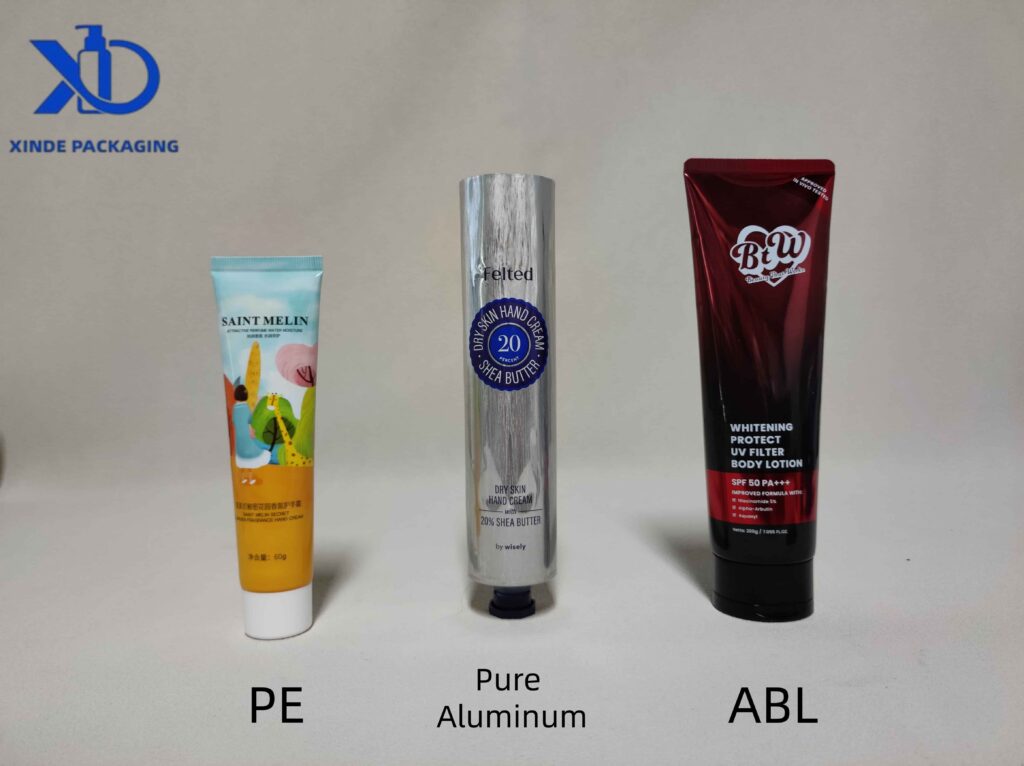
ABL = aluminum-plastic laminate (metal foil barrier, maximum protection, visibly “tin” feel). PBL = all-plastic laminate (EVOH barrier, fully squeezable, recyclable-leaning). Both are laminated tubes built by a different process than co-extruded bodies.
Next in the Series
Once the recipe is set, the body is extruded → How Cosmetic Tubes Are Extruded. Series overview → Cosmetic Tube Manufacturing Process.
Work With a Factory That Can Show You the Process
Xinde Packaging (XDPACK) is a cosmetic plastic packaging source factory with 20+ years of experience and monthly capacity of 3 million+ tubes. ISO 9001:2015 certified (cert. no. 05126Q02540R053). Verified test reports, published for your independent verification: SGS FDA report TSNPC26001739001 · SGS PFAS 671-substance Not Detected report CANPC26010411601 · SGS REACH + PPWR (EU) 2025/40 report CANPC26014689301. If you’re looking for new tube packaging, feel free to contact us for more tube information.
→ Free standard samples (10,000 pcs MOQ), shipped worldwide (EU + US). All channels in one place: https://linktr.ee/xdpack?subscribe · Email info@xdpackcom.net · WhatsApp +852 4428 9016.