Summary: Tube extrusion is where a tube body gets its diameter, wall thickness, color, and — for multi-layer tubes — its barrier. This guide walks the four-step extrusion flow, the real process windows factories run, and the three control points that separate a good tube body from a leaking or delaminating one.
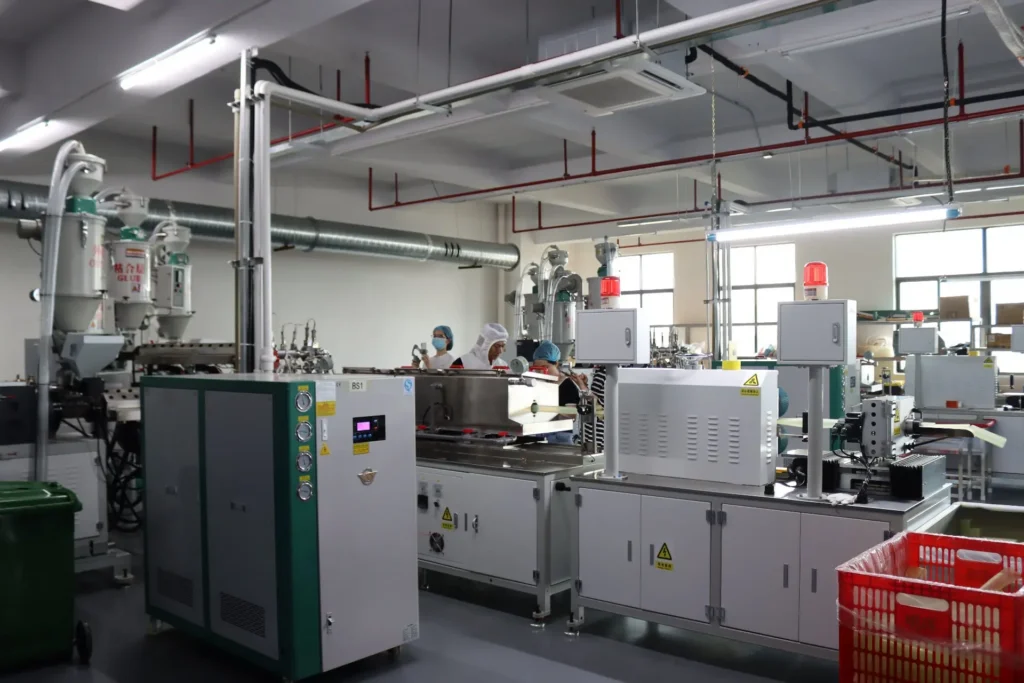
The Machine: What an Extrusion Line Actually Consists Of
A tube extrusion line has three systems:
- Control system — heating (heater bands, switches, temperature controllers), cooling (barrel and screw cooling), and parameter measurement.
- Drive system — motor group with low-speed startup and stepless speed control; belt or gear transmission.
- Extrusion forming system (the core) — hopper/feeding, extrusion barrel, extrusion screw, breaker plate, and the die head. The screw is the heart of the machine: it melts, mixes and meters the resin.
The Process Flow: 4 Steps
Feeding (masterbatch + resin, layer distribution for multi-layer) → melt co-extrusion (temperature and screw speed control) → sizing (sizing ring, vacuum, water cooling) → cutting (traveler table, inverter-set length, cutter speed) → tube body.
Typical Process Windows
| Parameter | Typical window |
| Melt temperature — outer/inner layers (5 zones) | 145–155°C |
| Melt temperature — middle/adhesive layer (5 zones) | 180–185°C |
| Die temperature — 3 zones (soft/hard) | 150–165°C |
| Cooling water | 8 ± 2°C (two-point sizing at 50 / ambient) |
| Vacuum for diameter sizing | 0.018 ± 0.003 MPa |
| Screw speeds (traveler / inner / outer / adhesive / middle) | 700 / 470–490 / 350–380 / 480–550 / 330–350 rpm |
| Die-to-sizing-ring distance | 20–70 cm |
| Line speed | 7–10 m/min |
Why the middle layer runs hotter (180–185°C): the adhesive tie-layer resin needs a higher melt temperature to bond PE to the EVOH barrier. If a factory runs the middle layer too cool, bond strength drops — and that failure shows up months later as delamination in the warehouse.
Tube Types a Line Can Produce
- By structure: single-layer, double-layer, multi-layer (5-layer with EVOH barrier)
- By color: transparent, colored
- By stiffness: soft, normal, hard (set by resin blend and wall thickness)
- By shape: round and custom oval/shaped bodies
Diameter and Length Boundaries
Standard cosmetic tube diameters run Ø13 mm to Ø60 mm (13, 16, 19, 22, 25, 30, 35, 38, 40, 45, 50, 55, 60). Practical length limits:
- Max ~200 mm — set by the printing press and diameter characteristics
- Min ~50–60 mm — set by sealing and diameter characteristics
Outside this window, yield drops and unit price rises — a frequent hidden cost in custom quotes. (See the full diameter-to-artwork-width table in our post-processing guide)
The 3 critical control points in extrusion
| Control point | Why it is critical | How it is checked |
| Material verification | Wrong lot = wrong tube, wrong color, wrong compliance story | Lot check at feeding — tightened inspection |
| Barrier layer integrity | A missing or incomplete EVOH layer means zero gas barrier while the tube still looks fine | Peel test: cut the tube mouth, peel each layer (outer / tie / barrier / inner) apart — no layer may be missing or incomplete |
| Bond strength between layers | Weak bonding → delamination in filling or on shelf | Specified ≥ 5 N/15 mm |
Non-critical points — diameter, length, wall thickness, color, stiffness, appearance — are not ignored; they run under normal/relaxed inspection, 100% monitored on the line.
Common Extrusion Defects (and What They Tell You)
Delamination, scratches, batch color variation, melt “fisheyes”/streamers, water lines, bent tube bodies, deformed tube mouths, lines, black spots. Visual inspection is done properly: corrected vision ≥ 1.2, no color blindness, under D65 standard light (or natural light), viewing at 30–40 cm, straight-on — not a casual glance on the line side.
FAQ
How do I verify the barrier layer is really in my tube?
Ask for a peel-test photo/report: each layer peeled apart and identifiable. Layer count claims without peel evidence are marketing.
Why is my custom 45 mm length tube quoted higher than a standard length?
Probably it sits near the 200 mm or 50–60 mm boundary where yield drops, or it needs a non-standard inverter setting — ask for the yield explanation.
What diameter tolerance should I expect?
Diameter is vacuum-sized at 0.018 MPa ±0.003; expect the supplier’s spec sheet per diameter, and always proof artwork on a real flattened tube since PE shrinks slightly with heat.
Next in the Series
The body is done — now the head → Tube Head & Shoulder Injection Molding. Series overview → Cosmetic Tube Manufacturing Process.
Work With a Factory That Can Show You the Process
Xinde Packaging (XDPACK) is a cosmetic plastic packaging source factory with 20+ years of experience and monthly capacity of 3 million+ tubes. ISO 9001:2015 certified (cert. no. 05126Q02540R053). Verified test reports, published for your independent verification: SGS FDA report TSNPC26001739001 · SGS PFAS 671-substance Not Detected report CANPC26010411601 · SGS REACH + PPWR (EU) 2025/40 report CANPC26014689301. If you’re looking for new tube packaging, feel free to contact us for more tube information.
→ Free standard samples (10,000 pcs MOQ), shipped worldwide (EU + US). All channels in one place: https://linktr.ee/xdpack?subscribe · Email info@xdpackcom.net · WhatsApp +852 4428 9016.