Summary for buyers: An airless bottle is the most assembly-intensive package in cosmetic plastics — body, piston, pump and actuator must come together with tolerances tight enough to hold a vacuum. This guide walks the full production flow (material drying → body forming → decoration → pump & piston assembly → vacuum testing), with the real parameters and acceptance standards used on the factory floor, plus a buyer checklist you can paste straight into an RFQ.
Why Airless Bottles Are Different From Ordinary Pump Bottles
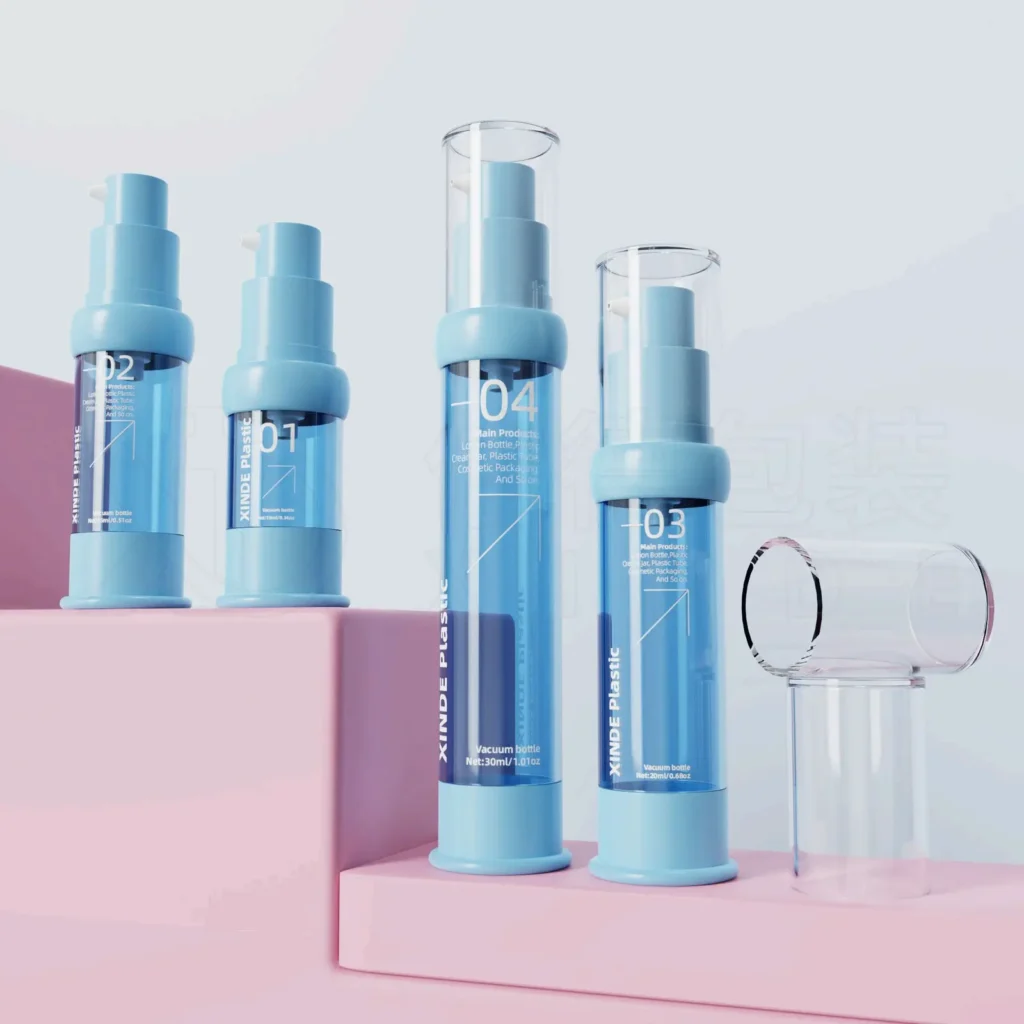
A lotion pump bottle draws product up a dip tube, with air vented in to replace it. An airless (vacuum) bottle does the opposite: a piston sits on top of the formula, and each press of the pump creates a vacuum that the pressure differential (ambient vs. in-bottle) drives the piston up — the product is dispensed by vacuum, never touching air. Three consequences buyers care about:
- Actives stay protected. No air ingress means vitamin C, retinol and preservative-light formulas oxidize slower.
- Near-zero residual. The piston follows the formula to the bottom — no product stranded in a dip tube.
- Every-orientation dispensing. The bottle works upside down and on its side.
The trade-off: with no dip tube to hide behind, the whole system — body inner wall, piston seal, pump valve — must be dimensionally right. That is why the manufacturing process and its checkpoints matter more here than in any other plastic pack.
Anatomy of an Airless Bottle: 5 Components, 6 Materials
| Component | Typical material | Function |
| Bottle body | PP, AS, PETG, PET (double-wall versions: outer PET/PMMA + inner PP) | Holds the formula; inner wall diameter tolerance is what the piston seals against |
| Piston | PE | Slides up the inner wall; the actual vacuum seal |
| Pump | PP (occasionally ABS) | Metering valve — must match the body’s neck finish exactly |
| Actuator / shoulder | PP | The press button and collar; defines dosage feel |
| Cap / hood | PP | Closure and protection during transport |
Three pump families exist: spray pumps (mist, for toners and sunscreen), lotion pumps (metered dose), and vacuum pumps (airless — for high-active products). Output per stroke is set by the pump core size, typically 0.1–0.5 cc for lotion pumps; dosage and press count can be tuned to the formula’s viscosity. Pump and body threads must match precisely — smooth pressing with no leakage is the acceptance baseline, and it starts at the neck-finish spec, not at assembly.
Standard airless bodies run from 15 ml to 150 ml across common neck finishes (16 / 20 / 32 / 42 mm thread diameters), with 5–500 ml available for dispensers on request.
Stage 1: Material Handling and Drying
PET and PETG are hygroscopic — absorbed moisture turns to steam during melting and shows up as bubbles and haze in the finished wall. Resin is dried before forming at 160–170°C (PET) and 60–70°C (PETG) for 4–6 hours. Skipping or shortening drying is invisible at the machine and ruinous at the filling line; it is one of the quiet difference-makers between a Tier-1 and a Tier-3 supplier.
Stage 2: Body Forming — Two Routes
Route A — Injection molding (PP and AS bodies, pistons, actuators, caps). High-pressure injection into precision molds; wall uniformity here directly determines how well the piston seals later. We break the whole route down — parameter windows, tolerances and the five control points — in our injection molding guide. PP bodies are the workhorse for airless (they survive piston friction and sterilization cycles); AS gives glass-like transparency for small-format display packs.
Route B — Two-step stretch blow (PET and PETG bodies):
- Preform injection — dried resin injection-molded into a test-tube-shaped preform.
- Preform heating — infrared oven brings the preform to its forming window: ~90–110°C for PET, ~80–100°C for PETG, heated evenly for uniform stretch.
- Stretch blow — a stretch rod elongates the preform while high-pressure air expands it against the mold wall; temperature and pressure control here set transparency and dimensional accuracy.
- Cooling & demolding — rapid air/water cooling locks the shape before shrinkage distortion sets in.
- Trimming — neck and parting-line excess cut and finished smooth — the neck face that will seat the pump must be flat and clean.
- Inline inspection — leak (pressure) test, pressure resistance, visual checks before any bottle moves downstream.
Stage 3: Decoration
Airless bodies accept the full decoration set: silk-screen printing, spray coating (including frosted/soft-touch effects), hot stamping, water transfer printing, and labeling, with custom Pantone color matching on both solid and frosted finishes. Each route has its own playbook: for ink systems, corona/flame treatment and the adhesion tests behind a print that survives handling, see our silk-screen printing guide.
Two decoration cautions specific to airless materials:
- AS and PETG are solvent-sensitive. Aggressive inks or coatings can cause stress cracking (crazing) — ink systems must be qualified per substrate, not assumed from PP experience.
- Non-polar PP needs surface treatment (corona/flame to ≥ 36 dynes/cm) before ink or coating will bond — the same rule as tubes. Decoration before piston assembly, always: stray ink or coating inside the body will fight the piston seal. And when the artwork calls for metallic accents, foil is its own craft — our hot stamping guide covers foil selection and the temperature–pressure–dwell window.
Stage 4: Pump, Piston and Assembly
This is where airless bottles are won or lost:
- Neck-finish matching. Pump thread, body thread and cap thread come from one controlled spec. A mismatch of fractions of a millimeter shows up as leaks or a wobbly actuator.
- Piston insertion. The PE piston is sized to the body’s inner wall; too loose = vacuum failure, too tight = piston stalls.
- Pump seating. The pump collar seals onto the neck face; seating force and squareness are checked, not assumed.
- Actuator / shoulder / hood assembly. Press feel and actuator alignment — a buyer’s hand notices a crooked actuator instantly.
- Functional check — priming presses, then per-stroke dosage consistency against the 0.1–0.5 cc spec.
If you fill yourself, confirm who inserts the piston: piston-in-bottle (you fill, then seat the pump — the piston rises as you fill) and pre-assembled pump units filled through the bottom valve are different workflows with different filling-line requirements — we compare them side by side in our assembly guide. Say which one your filler runs.
Stage 5: Quality Checks — What “Passed” Actually Means
A defensible airless QA standard is written, numeric and witnessed. The acceptance standard used in our contracts is explicit:
Filled with water as the test medium, held in a vacuum test machine at -0.05 MPa for 8 minutes — zero leakage passes. If the buyer cannot supply the actual formula, water is also used to verify pump spray/dispensing performance. Both parties inspect and accept against this standard. What the test proves, what runs around it in batch release, and how AQL sampling turns “passed” into verifiable evidence — that is the subject of our quality inspection guide.
Around that core test, batch release runs:
- Sealing & pressure resistance — pressure test on every batch.
- Drop test — filled-bottle drop per spec.
- Fit tests — pump/cap torque and thread fit on every batch.
- Dispensing function — priming count, per-stroke dosage within spec, no dribble.
- Visual inspection — under D65 standard light, corrected vision ≥ 1.2, at 30–40 cm.
- AQL sampling per GB/T 2828.1 (the international standard ISO 2859-1 equivalent) rather than ad-hoc “looks fine” release.
Documentation is part of QC: SGS material testing to US FDA 21 CFR 177.1520 and 177.1630 (food-contact grades), California Prop 65 statement, and SGS PFAS screening covering 671 substances (not detected) are supplied with report numbers, not adjectives. Passing QC is not the end of the line. Bottles then face weeks at sea, where dust, stacking pressure and a crushed carton corner can undo everything upstream — our export packing guide walks the last stage, from dust control to carton drop protection.
Buyer Checklist: Paste Into Your Next Airless RFQ
- Neck finish spec (thread diameter + finish standard) for body, pump and cap.
- Pump type and dosage (cc per stroke) + press count to prime.
- Piston material and whether it ships inserted or separately.
- Test standard in writing: vacuum 0.05 MPa / 8 min / water medium / zero leakage — or your own equivalent.
- AQL level and sampling standard (GB/T 2828.1 / ISO 2859-1), plus which tests run every batch (sealing, drop, fit).
- Decoration method and substrate compatibility confirmation (AS/PETG solvent check).
- Compliance docs with verifiable report numbers: FDA material test, PFAS screening, REACH/PPWR statement.
- Pantone references per component (body / shoulder / actuator / cap), on plastic chips not paper.
FAQ
Why do the first presses dispense nothing?
Priming: the pump chamber fills and the vacuum system establishes itself. A well-made airless bottle primes within a specified number of presses (typically 2–5 depending on pump size) — get the guaranteed priming count in writing, not as a surprise.
Can airless bottles handle hot-fill?
PP bodies and pumps tolerate warm fill; PET/AS/PETG bodies have narrower windows. If your filling line runs hot or uses tunnel pasteurization, state the temperature profile in the RFQ — it changes the material recommendation.
Which body for alcohol-heavy or acidic formulas?
PP is the safest default; PETG and AS need a compatibility check with the actual formula before mass production. Send the formula’s key characteristics (solvent content, pH) with the RFQ.
Single-wall or double-wall airless?
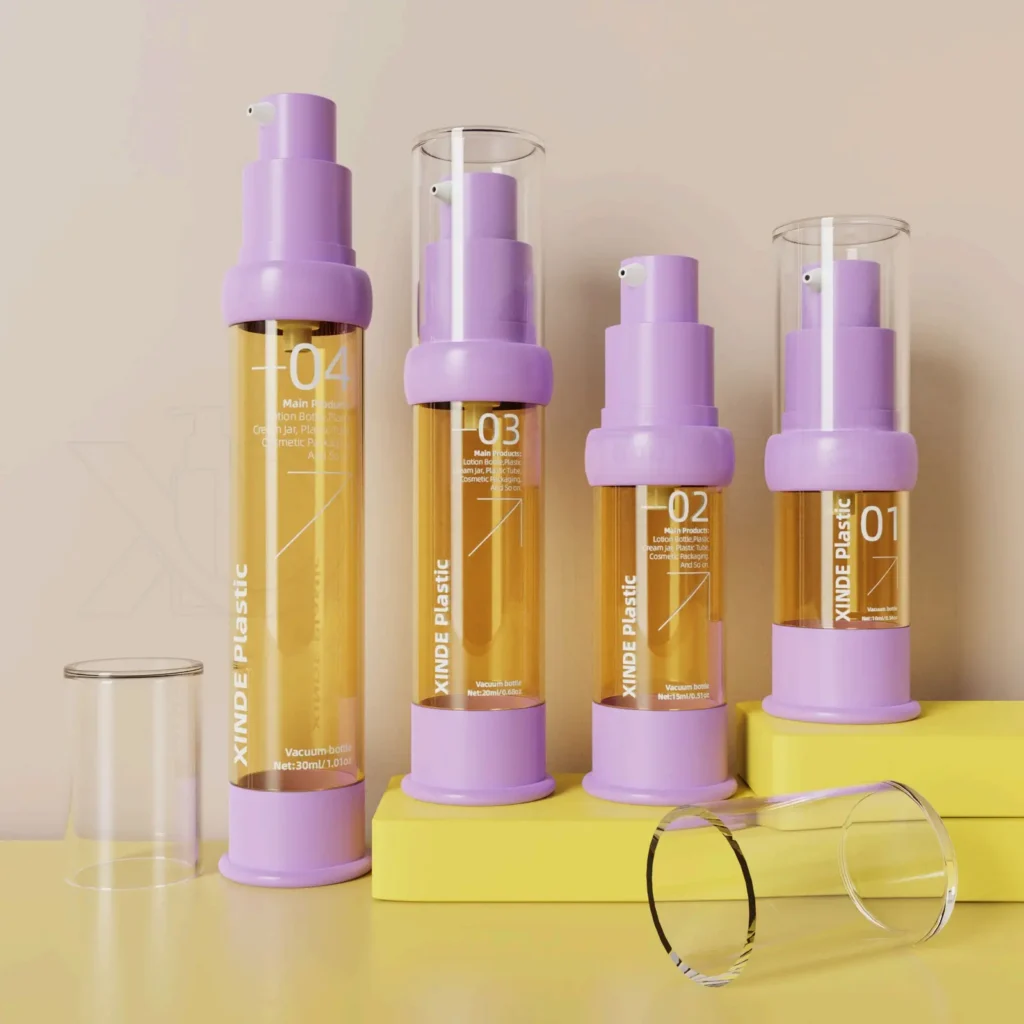
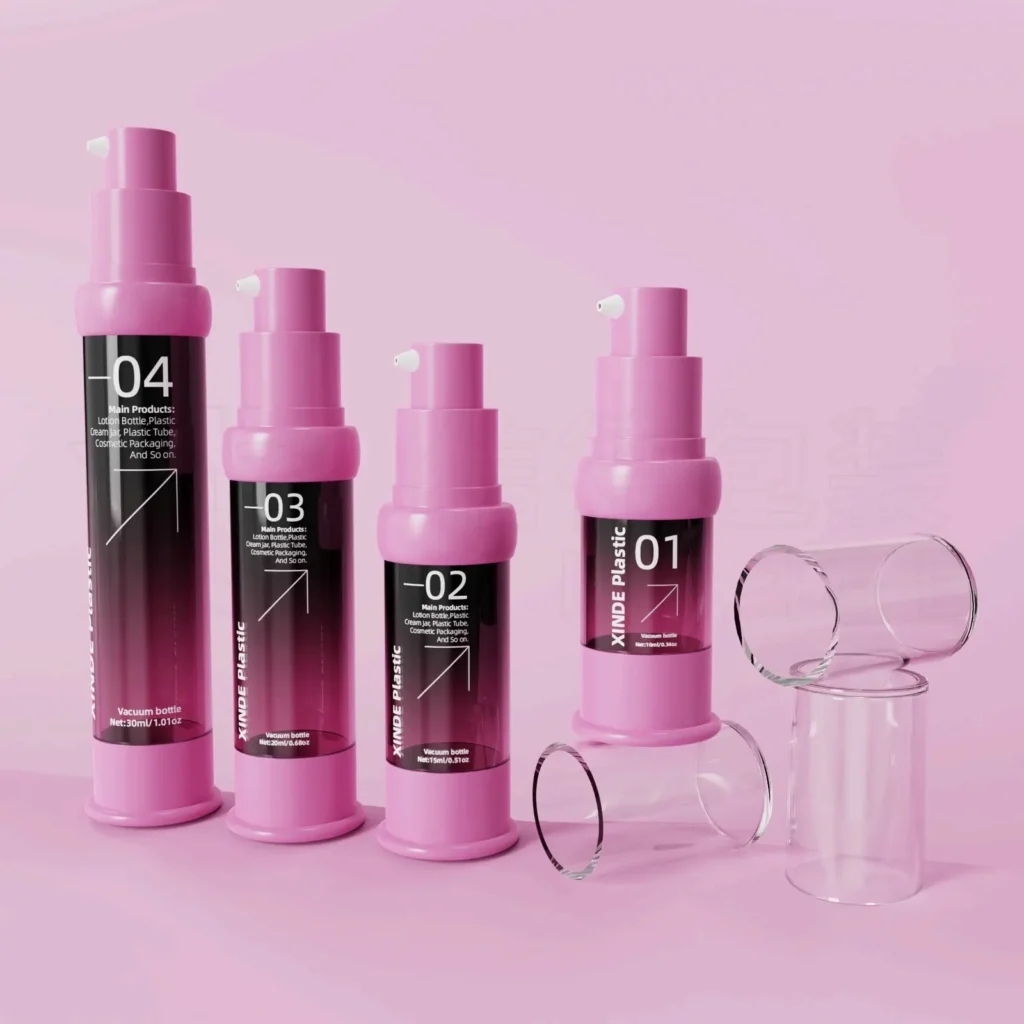
Double-wall (frosted outer PET/PMMA + colored inner PP) gives a premium two-material look and lets the inner bottle carry the formula while the outer shell carries the design — it costs more per set and adds a wall-alignment checkpoint to QC.
What MOQ should I expect?
Standard airless SKUs run at 10,000 pcs MOQ; capacity-dependent tooling and special finishes may need higher volumes.
Work With a Factory That Can Show You the Process
Xinde Packaging (XDPACK) is a cosmetic plastic packaging source factory with 20+ years of experience and monthly capacity of 3 million+ units. ISO 9001:2015 certified (cert. no. 05126Q02540R053). Verified test reports, published for your independent verification: SGS FDA report TSNPC26001739001 · SGS PFAS 671-substance Not Detected report CANPC26010411601 · SGS REACH + PPWR (EU) 2025/40 report CANPC26014689301. If you are looking for airless packaging solutions for your formula, please feel free to contact us for more information about our airless pump bottles.
→ Free standard samples (10,000 pcs MOQ), shipped worldwide (EU + US). All channels in one place: https://linktr.ee/xdpack?subscribe · Email info@xdpackcom.net · WhatsApp +852 4428 9016.