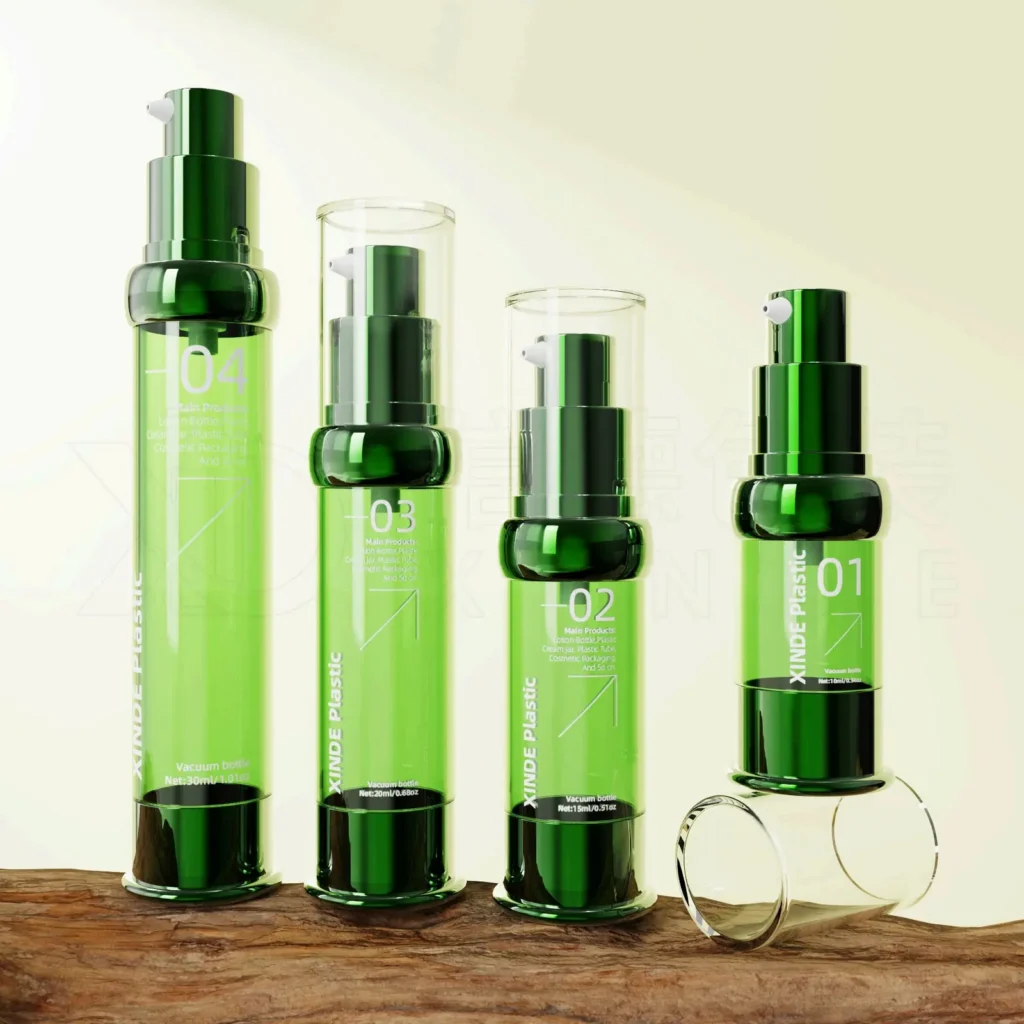
Summary: Injection molding is the default forming route for airless bottles — it produces the PP body, the PE piston, the pump housing, the actuator and the cap, all of which must hold tolerances tight enough to seal a vacuum. This guide walks the process flow, the real parameter windows, and the control points that decide whether your piston glides or stalls.
Why Injection Is the Default Route for Airless
Unlike lotion pump bottles, an airless bottle has no dip tube to hide behind. The piston seals directly against the bottle’s inner wall, so that wall’s diameter must be round, straight and consistent from bottom to shoulder. Injection molding into a precision steel mold is how you get that — blow-molded or extruded walls vary more. That is also why PP dominates airless bodies: it survives piston friction, warm-fill cycles and sterilization without stress cracking. AS gives glass-like transparency for small display formats; PETG adds premium clarity at a higher material cost.
What Gets Injection Molded
| Component | Typical material | Why the mold matters |
| Bottle body | PP (or AS / PETG) | Inner-wall tolerance is what the piston seals against |
| Piston | PE | Interference fit to the body — ±0.05 mm class tolerances |
| Pump housing | PP (occasionally ABS) | Metering valve; must match the neck finish exactly |
| Actuator / shoulder | PP | Defines dosage feel and press alignment |
| Cap / hood | PP | Closure; thread must match body without wobble |
The Process Flow
Feeding (resin + color masterbatch) → melting (temperature and pressure controlled) → mold forming and cooling → de-molding. For PET and PETG bodies, resin is dried first at 160–170°C (PET) and 60–70°C (PETG) for 4–6 hours — absorbed moisture turns to steam in the melt and shows up as bubbles and haze that no amount of post-processing can fix. PET bodies can also run the two-step stretch-blow route (preform → IR heating → stretch blow → trim); PP airless bodies and all small components stay on injection.
Typical Injection Parameter Windows
| Parameter | Typical window |
| Melt temperature | 245 ± 5°C |
| Injection pressure | 6 ± 0.5 MPa |
| Cooling water temperature | 8 ± 2°C |
| Cooling time | 8–10 s |
| Cycle time | 18–25 s per shot |
The 5 Control Points Specific to Airless Bodies
| Control point | Failure mode if uncontrolled |
| Inner-wall diameter tolerance | Piston too loose = vacuum failure; too tight = piston stalls |
| Neck finish squareness and thread spec | Pump leaks or sits crooked; cap wobbles |
| Sink marks and voids in the wall | Weak spots visible after frosting or coating |
| Flash at the parting line | Sharp edges; piston snagged mid-stroke |
| Component dimensional consistency (piston, pump core) | Dosage drifts between batches |
All five run under tightened inspection at first-article and in-process checks; final shipment release runs normal or relaxed stringency per the sampling standard.
FAQ
Can you match my existing pump?
No, for standard specification airless bottles, the pump is fixed, and all airless bottles are sold as a complete set. It is not supported to sell the bottle and pump separately. If you have special requirements for the pump style, you can consider customizing the mold.
Why PP instead of PET for the whole bottle?
PP tolerates piston friction and warm fill. PET gives wall clarity and runs the stretch-blow route — many premium airless designs combine a PET outer with a PP inner. State your formula’s solvent content and fill temperature in the RFQ; the material recommendation follows from those two facts.
What causes haze or bubbles in a transparent airless body?
Almost always under-dried resin. Ask any supplier how long and at what temperature they dry PET/PETG before molding — 160–170°C (PET) and 60–70°C (PETG) for 4–6 hours is the working window.
Next in the Series
Body formed — time to decorate → Silk-Screen Printing on Airless Cosmetic Bottles. Series overview → How Airless (Vacuum) Cosmetic Bottles Are Made.
Work With a Factory That Can Show You the Process
Xinde Packaging (XDPACK) is a cosmetic plastic packaging source factory with 20+ years of experience and monthly capacity of 3 million+ units. ISO 9001:2015 certified (cert. no. 05126Q02540R053). Verified test reports, published for your independent verification: SGS FDA report TSNPC26001739001 · SGS PFAS 671-substance Not Detected report CANPC26010411601 · SGS REACH + PPWR (EU) 2025/40 report CANPC26014689301. If you are looking for airless packaging solutions for your formula, please feel free to contact us for more information about our airless pump bottles.
→ Free standard samples (10,000 pcs MOQ), shipped worldwide (EU + US). All channels in one place: https://linktr.ee/xdpack?subscribe · Email info@xdpackcom.net · WhatsApp +852 4428 9016.